
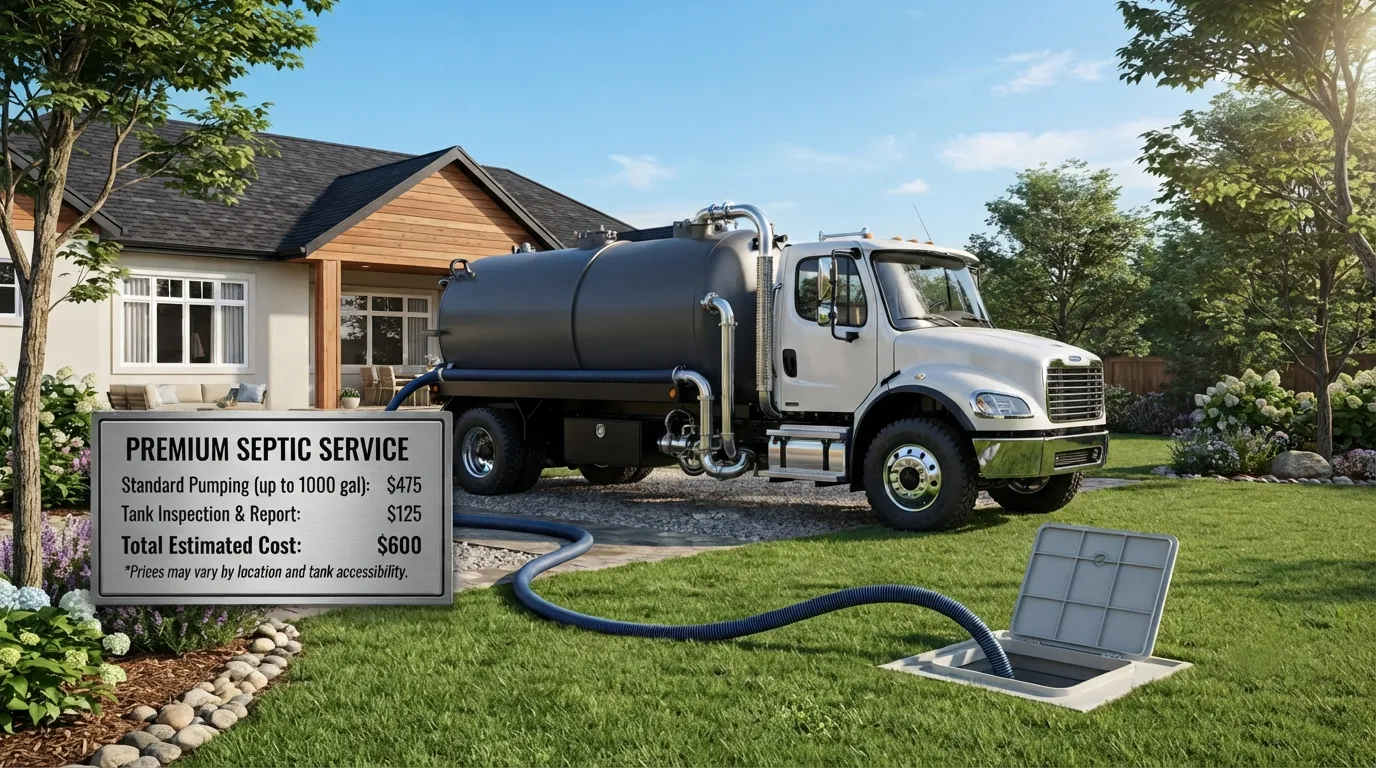
How much does septic tank pumping cost?
Most Fullerton homes with a standard 1,000 gallon tank land in the 150 to 300 dollar day-rate band, and that number swings on tank access, how compacted the solids are, and drive time to the truck's disposal point. A tank buried under a deck or behind a fence costs more to reach than one with a clear lid at grade, and the same access issue shows up when a temporary fence rental has to be moved to get equipment through. Weekend service costs extra and sits closer to the 50 to 150 dollar range on top of the base call, since crews are working outside the normal schedule. If you are budgeting for a rental property or a home you are about to list, our septic pumping service page breaks down what a service call includes beyond the pump-out itself. Homes further out toward Placentia, about 6.0 miles east, or Brea, 5.8 miles northeast, see the same pricing since the cost is driven by the job, not the ZIP code.
What drives septic tank cleaning prices up or down?
Tank size is the biggest lever, much like unit count is the biggest lever on our porta potty rental cost page. A 1,000 gallon tank pumped on a normal schedule costs less per visit than a tank that has gone years past due and packed solids to the bottom. Residential tanks are typically pumped every 3 to 5 years, and that interval depends on tank size and how many people are in the house, which is worth checking against our how often to pump a septic tank guide before you assume you are overdue. Access matters too: a tank with a riser at grade takes less labor than one that needs digging, similar to how a dumpster permit requirements question comes down to where the container has to sit on the property. Grease interceptors are a different animal entirely, they get pumped once fats, oils, grease and solids reach 25 percent of the liquid depth, and that schedule has nothing to do with a home septic tank's 3 to 5 year cycle. If you run a restaurant or commercial kitchen in Fullerton, see grease trap pumping for that separate cost structure.

Septic pumping cost comparison
| Service | Duration | Low | Typical | High |
|---|---|---|---|---|
| Septic pump-out | Day rate | $150 | $250 | $300 |
| Septic pump-out | Weekend | $50 | $100 | $150 |
These numbers cover the pump-out call itself. They do not include a holding tank rental if your system fails and you need a bridge solution while repairs happen, which is covered separately on our holding tank rental page. If your tank has already backed up or you are dealing with a slow drain and sewage smell, check septic tank warning signs before you wait for a scheduled visit, and call our emergency septic service line if it is already flooding.
Is septic tank pumping cheaper than a full system replacement?
Yes, by a wide margin. A pump-out is a maintenance cost measured in a couple hundred dollars, closer in scale to a porta potty rental per day charge than to a repair bill. A failed leach field or a collapsed tank is a repair project, not a service call, and it is the outcome you are pumping to avoid. Staying on a 3 to 5 year cycle for a standard 1,000 gallon tank is the cheapest way to keep a septic system out of failure mode, the same logic that applies to routine septic tank cleaning versus waiting for a backup. Skipping pump-outs lets solids build past the point where a tank can settle waste properly, and that is what pushes water and solids into the drain field where they do real damage. If you are weighing tank cleaning against other project costs on your Fullerton property, such as a bathroom remodel that needs temporary facilities, our home renovation porta potty page covers what that side of the job runs.

Where does septic pumping fit with other site services in Fullerton?
Septic work rarely happens alone. A lot of Fullerton customers calling about a tank pump-out are also mid-renovation or clearing out a property, and they end up needing a roll-off dumpster rental for debris the same week. If the job involves digging near the tank or leach field, a construction crew on-site for more than a day or two needs sanitation under OSHA 1926.51(c), which sets toilet counts by crew size: one toilet for 20 workers or fewer, scaling up from there. That is separate from the potable water requirement under OSHA 1926.51(a)(1), which applies to any job site regardless of septic work, and worth reviewing alongside our OSHA portable toilet requirements guide before a crew starts digging. If the crew is applying sealants or coatings anywhere near the excavation, washing facilities also fall under OSHA 1926.51(f)(1), which covers paints, coatings, herbicides and insecticides specifically. For a longer dig or remodel, check construction site services or construction dumpster rental to plan the whole job at once instead of piecing it together call by call, and if the crew needs a place to store tools overnight, a storage container rental often gets added to the same order.
How often should I get my septic tank pumped?
Every 3 to 5 years for a standard residential tank, though household size and tank size shift that window. A bigger household fills a tank faster, the same way a bigger crew changes the math on our how many porta potties do I need guide. See how often to pump a septic tank for the fuller breakdown, and watch for warning signs in between scheduled visits rather than waiting out the full interval blind.
Does tank size change the price?
Yes. A 1,000 gallon tank is the common residential size and sits in the standard pricing band. Larger tanks, heavier solid buildup, or hard-to-reach access all push the price toward the higher end of the 150 to 300 dollar day-rate range, the same way unit type shifts pricing on our monthly porta potty rental page.
Is weekend septic service more expensive?
Yes. Weekend pumping runs 50 to 150 dollars above a standard weekday call, since it pulls a crew and truck outside the normal schedule. If your situation isn't a true emergency, booking a weekday slot is the cheaper route.
What is the difference between septic pumping and a grease trap service?
Septic tanks run on a 3 to 5 year cycle tied to household size. Grease interceptors get pumped when fats, oils, grease and solids hit 25 percent of liquid depth, which can happen far more often in a busy kitchen. See grease trap pumping for that schedule.
Can I rent a holding tank while my septic system is repaired?
Yes. A holding tank bridges the gap between a failed system and a completed repair so the property stays usable. Details and specs are on our holding tank rental page, worth checking before a repair timeline stretches longer than expected.

Next step
Get a delivery date
Tell us the address, the dates and the headcount. We size the order and confirm the route.